Showing posts with label bildungsroman. Show all posts

Reading is One Form of Escape. Running for Your Life is Another.
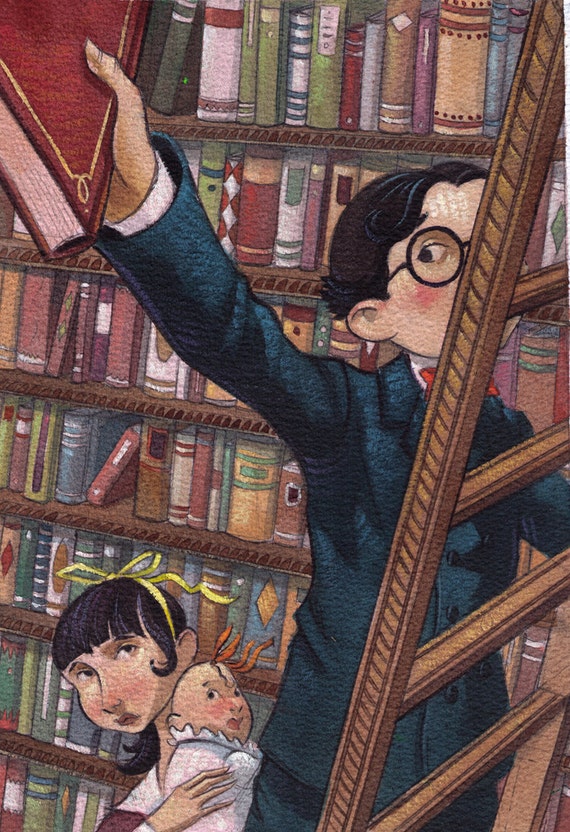
Illustration by Brett Helquist

"All of the secrets of the world are contained in books. Read at your own risk."
- Lemony Snicket

Today I'd like to talk about a series that has played a pivotal role in my own life as a young adult. Though categorised as "children's novels", the saga is that has the ability to make an impact on all young (and old!) readers. Of course, the series that I am fortunate enough to be discussing is Lemony Snicket's A Series of Unfortunate Events.

A Series of Unfortunate Events consists of 13 novels written by Daniel Handler under the pseudonym Lemony Snicket. It follows the lives of three children, Violet, Klaus and Sunny Baudelaire, after the mysterious death of their parents. After being placed into and then escaping the custody of their villainous relative Count Olaf, they are pursued throughout all 13 books by Olaf and his henchmen, who wish to steal the children's vast fortune. As the series progresses it is revealed that everything is not as it seems, as they are faced with a variety of strange obstacles, people and places and begin to uncover more and more about a secret organisation only known as VFD. They discover and unravel several mysteries, but in the end not everything can be explained.

The story is narrated by Lemony Snicket, who works tirelessly to uncover the truth about what happened to the Baudelaires, though he finds the tale almost to sad and unfortunate for anyone to bear. With a cynical, yet humorous tone, he often urges the reader to put the book down and pursue more enjoyable and pleasant hobbies but his clever and unique way of writing keeps you drawn to the children's tale of woe.

"Grief, a type of sadness that most often occurs when you have lost someone you love, is a sneaky thing, because it can disappear for a long time, and then pop back up when you least expect it."
- The Carnivorous Carnival

Perseverance is one of the key themes featured in ASOUE. The Baudelaires are portrayed as being admirable for their vitality. The siblings coping with loss is an important feature as it allows the reader to develop an understanding of grief, or relate to characters suffering with despondency. In The Austere Academy Snicket observes that “Friends can make you feel that the world is smaller and less sneaky than it really is, because you know people who have similar experiences.” Fictional characters are no exception to this rule. In a time where a young person may be feeling alone, being able to relate to someone has the capacity to be a great comfort. Throughout the series, Snicket seems to urge the reader to find courage in him or herself and in his or her friends and if not to challenge despondence then at least to take it with a grain of salt. It also looks at perseverance and bravery as playing key roles in the triumph over evil.

“Fate is like a strange, unpopular restaurant filled with odd little waiters who bring you things you never asked for and don't always like.”
- The Slippery Slope

As I briefly touched upon in Daniel Handler on Childhood, one of the important lessons taught by ASOUE is the importance of continually asking questions, and the reality that not all of these can be answered. Though the series is extravagant and sometimes ridiculous, there are many core elements that bring it back to reality and provide a lesson without the almost offensive tidy moralising implemented in many YA novels. "For some stories, it's easy. The moral of The Three Bears, for instance, is 'Never break into someone else's house.' The moral of Snow White is 'Never eat apples.' The moral of World War I is 'Never assassinate Archduke Ferdinand." (The Wide Window). While many of the critical plot points are given answers, Snicket explains that no story can be fully devoid of questions as every story is intertwined with numerous others and every character's history is shared in a great web of mysteries and unfortunate events that make up the world's legacy, making it impossible for anyone to know all the answers to every question. By leaving loose ends and questions unanswered Snicket provides a sort of comfort for young readers by reminding them that it's okay to be confused and bewildered by the world, because the world is a confusing and bewildering place. Though you may not think you're able to so easily slip into the shoes of three orphans stuck in the midst of a villainous plot, in the end everyone is able to relate to the feeling of being lost, confused and trying to find their place in the world.

"People aren't either wicked or noble. They're like chef's salads, with good things and bad things chopped and mixed together in a vinaigrette of confusion and conflict."
- The Grim Grotto 

The mysterious organisation VFD is a main feature in the books. Exactly what VFD does is unclear, as its members go to great lengths to conceal all traces of their activities. However, it is strongly suggested that the main purpose of the organisation is firefighting, amongst many other humanitarian acts. There's also a great respect held for literature, and it is believed that people who read cannot be evil. In Daniel Handler on Childhood Handler mentioned that the question he is most often asked about the series is "Is [VFD] real? Is there really a secret society of literature?" to which he replies,"Yes, and you're in it."

VFD stands for humanitarianism and the importance of being well-read, and we're all members. However, it also stands as an acknowledgment that there are as many good people as bad people in the world. Though there are many observations of the distinction between good and evil, and how right will always come out on top ("Right, good temporarily defeated, is stronger than evil triumphant.” - The Reptile Room) as the series progresses it begins to display strong themes of moral relativism, as the Baudelaires become more confused during the course of the series about the difference between right and wrong, feeling they have done wicked things themselves and struggling with the question of whether the end justifies the means. Evil characters are shown to have sympathetic characteristics and often have led difficult lives. Similarly, good characters' flaws become major problems. Almost every major character in the books has lived a life as difficult as that of the Baudelaires, especially the villains. In The End Count Olaf, a past member of VFD, observes that he's "no worse than anyone else", and it is an unsettling moral lesson to think that, in some ways, he may be right.

These complex moral views along with a myriad of other themes drives ASOEU and has resulted in it being an exceptional piece of literature that has a lesson for all readers. It's a reminder of some of the realities of life, tied up in a bizarre tale about three orphans who've done nothing to deserve their fate but keep their chins up regardless.

For those who read last weeks entry, the answer is of course D. Life is a nightmare, so why not have one?

The Ocean is Six Miles Deep


"I don't know if I've come of age, but I'm certainly older now. I feel shrunken, as if there's a tiny ancient Oliver Tate inside me operating the levers of a life-size Oliver-shaped shell. A shell on which a decrepit picture show replays the same handful of images. Every night I come to the same place and wait till the sky catches up with my mood. The pattern is set. This is, no doubt, the end.”
-Joe Dunthorne, Submarine

In the seaside town of Swansea, Wales lives almost 15 year old, Oliver Tate. Precocious and with a penchant for theatrics, Oliver is navigating his way through the murky and uniquely perilous waters of adolescence. Joe Dunthone’s 2008 critically acclaimed novel Submarine is a coming-of-age story that has connected with young adults all over the world, and continues to reach broader audiences as a film adaption released in 2010.

As Submarine was written by Dunthorne as a young adult studying creative writing at the University of East Anglia, it’s unsurprising that it is successful in connecting to the trials and tribulations of it’s readers. Though a coming-of-age novel in the most traditional sense, it can be better classified as a bildungsroman. A subset of the coming-of-age story, bildungsromans focus on the psychological and moral growth of a protagonist throughout their youth, in which character development is extremely important.

Concerned with taking it upon himself to resolve his parents teetering marriage, whilst attempting to seduce his classmate Jordana Bevan, and trying to figure out where he fits in the world, Oliver masters his formidable, uninhibited powers of imagination in order to put everything in its right place.

"Depression comes in bouts. Like boxing. Dad is in the blue corner."
Upon finding an empty bottle of tricyclic antidepressants in the bin by his dad's bedside table, Oliver discovers that his father struggles with bouts of depression. This is a common theme in YA fiction as it's presence has the ability to help readers on an individual basis. These novels have the opportunity to provide readers with a realistic representation of people struggling with depression, and serves as a constant reminder that you're not alone.

Oliver and Lloyd often pose the question "How deep is the ocean?" to one another, and this reoccurring thought serves as an anchor for reality as the answer is always the same. Though their lives may be rocked by the current or caught in a raging tempest, the depth of the ocean is a constant. In the film, this is further enhanced when Oliver requests that Jordana ask him how deep the ocean is, simply because he knows the answer.

Diving into the depths of middle-aged malaise is unsurprisingly difficult for a teenager. Especially for someone who has admitted that it’s “strange to hear your mother talk about being human because, honestly, it's too easy to forget.”
(Submarine 2010)
"I want the evening upon which we lose our collective virginities to be special. I'm no parthenologist but I suspect that Jordana's virginity is still intact. Her biological knowledge is minimal. She thinks that a perineum is to do with glacial moraine."
On his quest to commence a story of teenage passion with the troubled and alluring Jordana, Oliver discovers the difficulties of losing his virginity and trying to navigate the depths of heartache. Through love letters and attempts at grand romantic gestures, he stumbles his way through the world of romance, which he supposes probably "will not matter when [he's] forty-three".

The importance of the portrayal of love in YA fiction lies in it's serving as a reminder for why it matters so much, and that it's not something to take for granted. The role of love in Submarine is particularly interesting as it's told from the male perspective. Though love is a very popular topic among female readers, it is not as common that a story with a male protagonist looks at the ups and downs of love and sexuality. Typically, love is more often presented as a reward for the male hero, and not something they have to earn.

Additionally the way in which Dunthorne addresses sex is beneficial to the reader, as it is portrayed as a real thing that adults and teenagers have. Not talking about sex is unproductive, unrealistic and unhealthy for young people. It's important that it is not made out to be this perfect thing, but nor is it something that is scary and should be avoided. The use of sexuality in YA fiction is useful in encouraging healthy and safe exploration of sexuality.

“I spin around on the swivel chair and look up at the ceiling; Oliver being Oliver being Oliver being Oliver. I am suddenly aware of the separation between my-actual-self and myself-as-seen-by-others. Who would win in an arm wrestle? Who is better-looking? Who has the higher IQ?” 

Many coming-of-age stories highlight the difficulties of struggling to realise your own identity in the face of pressures to conform
. Though adults are certainly not immune from this idea, many young people struggle with the temptation to obscure individual interests or values in order to fit in. Oliver subscribes to this issue.

Though he does not approve of bullying, he finds himself being peer pressured into tormenting one of his classmates, Zoe Preece. Though decidedly aligning himself with his bully friends in order to impress Jordana, Oliver struggles with his guilt over taking part in Zoe's harassment. This in conjunction with his oddball nature and ever changing list of hobbies and interests, reads as an authentic take on someone struggling to discover their own identity.

The role of identity in YA fiction is a frequently occurring one as, in theory, finding your place between being a child and being an adult is a teenagers main concern. In this period you often try out different styles, different friends and different values, and as a result every young persons search for identity is unique. Reading provides the opportunity to slip into character as someone else, take on someone else's identity, and so can aid the development of your own.
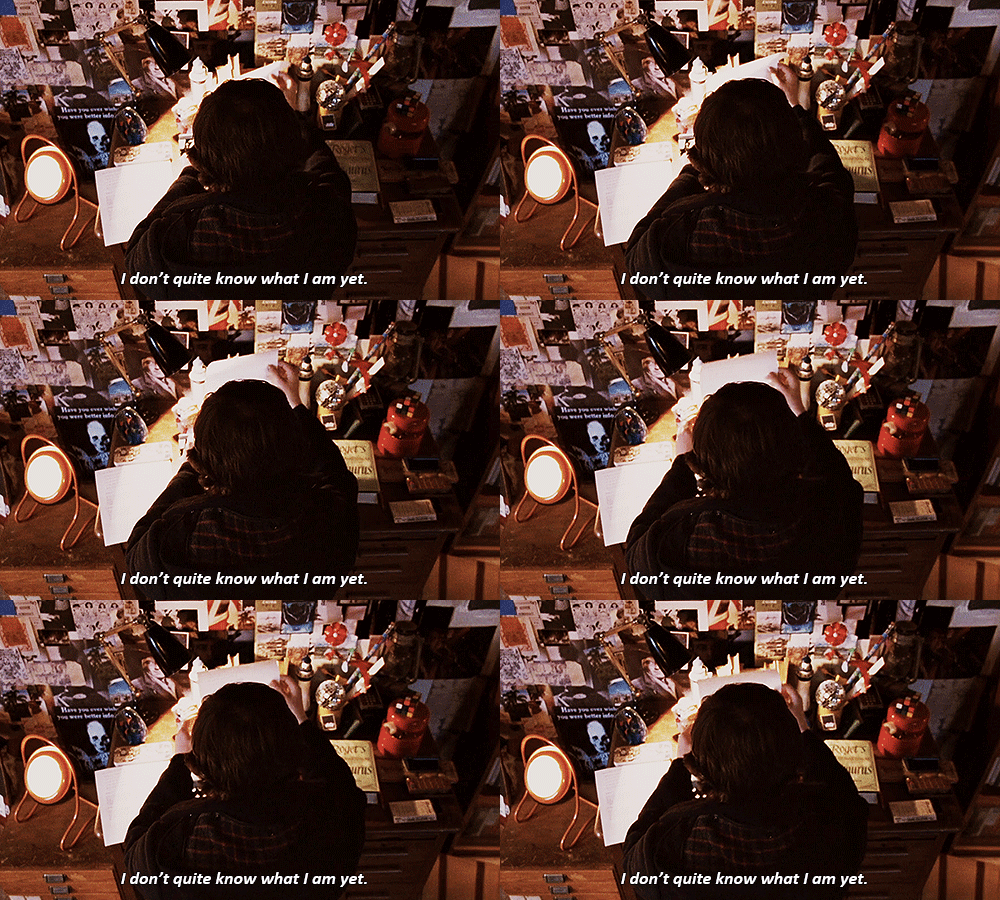
(Submarine, 2010)
In spite of some of the content in Submarine, Dunthorne does a remarkable job of dealing with serious issues in a fun and relatable way.

It's difficult being a teenager and realising that you can't control everything, nobody can, and that your parents are people too and often are as clueless as you are. Everyone is in the same boat and the only thing that you can be certain about is that the ocean is six miles deep. Spending time with fictional characters who's problems may be similar, though often exaggerated, allows the reader to find solace and look at aspects of themselves or their lives that may be otherwise painful to look at. Following someone's journey into adulthood gives readers the opportunity to make sense of the messy business of growing up.

Joe Dunthorne's Submarine allows you to see and accept contradictions that are inherent in human behaviour and, just as Oliver realises that his problems will matter to him when he's forty-three, can encourage you to consider the events and moments in your own life that have marked your own coming of age.