Showing posts with label childhood. Show all posts

Reading is One Form of Escape. Running for Your Life is Another.
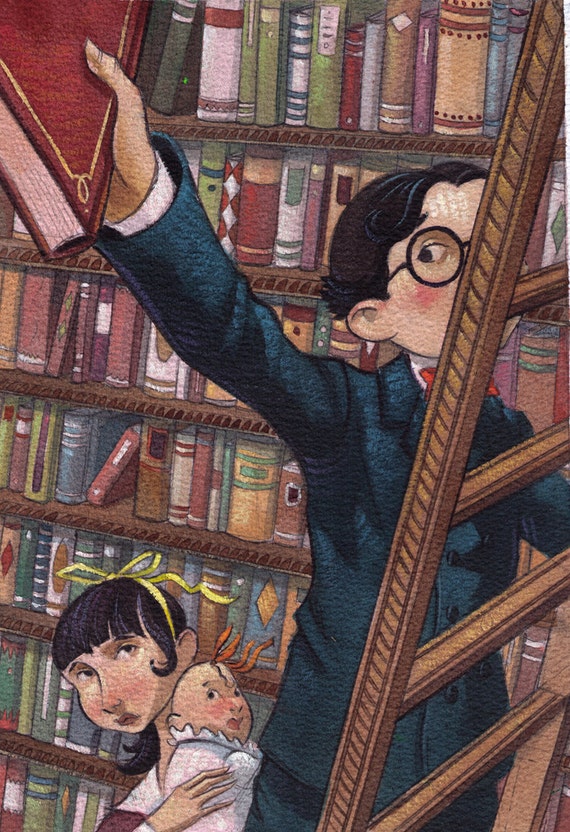
Illustration by Brett Helquist

"All of the secrets of the world are contained in books. Read at your own risk."
- Lemony Snicket

Today I'd like to talk about a series that has played a pivotal role in my own life as a young adult. Though categorised as "children's novels", the saga is that has the ability to make an impact on all young (and old!) readers. Of course, the series that I am fortunate enough to be discussing is Lemony Snicket's A Series of Unfortunate Events.

A Series of Unfortunate Events consists of 13 novels written by Daniel Handler under the pseudonym Lemony Snicket. It follows the lives of three children, Violet, Klaus and Sunny Baudelaire, after the mysterious death of their parents. After being placed into and then escaping the custody of their villainous relative Count Olaf, they are pursued throughout all 13 books by Olaf and his henchmen, who wish to steal the children's vast fortune. As the series progresses it is revealed that everything is not as it seems, as they are faced with a variety of strange obstacles, people and places and begin to uncover more and more about a secret organisation only known as VFD. They discover and unravel several mysteries, but in the end not everything can be explained.

The story is narrated by Lemony Snicket, who works tirelessly to uncover the truth about what happened to the Baudelaires, though he finds the tale almost to sad and unfortunate for anyone to bear. With a cynical, yet humorous tone, he often urges the reader to put the book down and pursue more enjoyable and pleasant hobbies but his clever and unique way of writing keeps you drawn to the children's tale of woe.

"Grief, a type of sadness that most often occurs when you have lost someone you love, is a sneaky thing, because it can disappear for a long time, and then pop back up when you least expect it."
- The Carnivorous Carnival

Perseverance is one of the key themes featured in ASOUE. The Baudelaires are portrayed as being admirable for their vitality. The siblings coping with loss is an important feature as it allows the reader to develop an understanding of grief, or relate to characters suffering with despondency. In The Austere Academy Snicket observes that “Friends can make you feel that the world is smaller and less sneaky than it really is, because you know people who have similar experiences.” Fictional characters are no exception to this rule. In a time where a young person may be feeling alone, being able to relate to someone has the capacity to be a great comfort. Throughout the series, Snicket seems to urge the reader to find courage in him or herself and in his or her friends and if not to challenge despondence then at least to take it with a grain of salt. It also looks at perseverance and bravery as playing key roles in the triumph over evil.

“Fate is like a strange, unpopular restaurant filled with odd little waiters who bring you things you never asked for and don't always like.”
- The Slippery Slope

As I briefly touched upon in Daniel Handler on Childhood, one of the important lessons taught by ASOUE is the importance of continually asking questions, and the reality that not all of these can be answered. Though the series is extravagant and sometimes ridiculous, there are many core elements that bring it back to reality and provide a lesson without the almost offensive tidy moralising implemented in many YA novels. "For some stories, it's easy. The moral of The Three Bears, for instance, is 'Never break into someone else's house.' The moral of Snow White is 'Never eat apples.' The moral of World War I is 'Never assassinate Archduke Ferdinand." (The Wide Window). While many of the critical plot points are given answers, Snicket explains that no story can be fully devoid of questions as every story is intertwined with numerous others and every character's history is shared in a great web of mysteries and unfortunate events that make up the world's legacy, making it impossible for anyone to know all the answers to every question. By leaving loose ends and questions unanswered Snicket provides a sort of comfort for young readers by reminding them that it's okay to be confused and bewildered by the world, because the world is a confusing and bewildering place. Though you may not think you're able to so easily slip into the shoes of three orphans stuck in the midst of a villainous plot, in the end everyone is able to relate to the feeling of being lost, confused and trying to find their place in the world.

"People aren't either wicked or noble. They're like chef's salads, with good things and bad things chopped and mixed together in a vinaigrette of confusion and conflict."
- The Grim Grotto 

The mysterious organisation VFD is a main feature in the books. Exactly what VFD does is unclear, as its members go to great lengths to conceal all traces of their activities. However, it is strongly suggested that the main purpose of the organisation is firefighting, amongst many other humanitarian acts. There's also a great respect held for literature, and it is believed that people who read cannot be evil. In Daniel Handler on Childhood Handler mentioned that the question he is most often asked about the series is "Is [VFD] real? Is there really a secret society of literature?" to which he replies,"Yes, and you're in it."

VFD stands for humanitarianism and the importance of being well-read, and we're all members. However, it also stands as an acknowledgment that there are as many good people as bad people in the world. Though there are many observations of the distinction between good and evil, and how right will always come out on top ("Right, good temporarily defeated, is stronger than evil triumphant.” - The Reptile Room) as the series progresses it begins to display strong themes of moral relativism, as the Baudelaires become more confused during the course of the series about the difference between right and wrong, feeling they have done wicked things themselves and struggling with the question of whether the end justifies the means. Evil characters are shown to have sympathetic characteristics and often have led difficult lives. Similarly, good characters' flaws become major problems. Almost every major character in the books has lived a life as difficult as that of the Baudelaires, especially the villains. In The End Count Olaf, a past member of VFD, observes that he's "no worse than anyone else", and it is an unsettling moral lesson to think that, in some ways, he may be right.

These complex moral views along with a myriad of other themes drives ASOEU and has resulted in it being an exceptional piece of literature that has a lesson for all readers. It's a reminder of some of the realities of life, tied up in a bizarre tale about three orphans who've done nothing to deserve their fate but keep their chins up regardless.

For those who read last weeks entry, the answer is of course D. Life is a nightmare, so why not have one?

Daniel Handler on Childhood

Photo by Meredith Heuer

Recently I was lucky enough to attend a secular sermon conducted by The School of Life Melbourne in which one of my favourite authors, Daniel Handler, spoke on childhood and the importance of literature. Handler may be better known to you as the official representative of author Lemony Snicket. "Official representative" being a phrase which here means the physical embodiment of Mr Snicket, and author of the popular YA series 'A Series of Unfortunate Events'. The opportunity to discuss what I learnt at 'Daniel Handler on Childhood' seemed too good to be true, as it is entirely fortunate that he just so happened to be discussing one of the very topics covered by Reads Like Teen Spirit.

If a story doesn't answer the questions of childhood, what can it do? Handler shared with us his answer to this question, an answer which he finds in a fan letter he received some time ago. The letter reads as follows:

"Dear Mr Snicket, I read your books. Why do I enjoy them so much? I am always curious when something happens. Your friend, Brandi."
The point being made here is that "this is why stories are interesting, and this is why good literature is good: because we're curious." He argues that curiosity is the one real reason why we engage with literature and that we shouldn't be afraid to ask questions.


So why does Lemony Snicket keep asking questions? In many YA novels our likeable hero or heroine is drawn into or finds themselves in an unpleasant situation; a family experiences a difficulty, death or moving, and our hero overcomes it and at the end everyone is happy. Bullies are stood up to, and evil is evaded. In A Series of Unfortunate Events Snicket/Handler tries to avoid this. He is not demanding realism in fiction, as his own stories do not mimic true life, but he is against the sort of "tidy moralising" presented in many novels. In reality, he says, there is always a "clique which will exclude you" and "bullies never get their comeuppance". However, this is good news as "eventually all of us act like bullies at one time or another and we would like our bully acts forgotten". In the real world people don't die based on whether they're of a pleasant character or not, and not all family issues may be overcome, though they can be absorbed in time. In summary, Handler dislikes the books that "shove the strangeness of the world into the tidiest, offensive conclusions rather than the real lessons that can be learned".

It is because of this that we must always be asking questions, and why Lemony Snicket keeps asking questions. As children we wonder what our place is in the world, and books are able to help answer many of our questions, as well as open up many more. Ultimately Daniel Handler on Childhood reinforced my belief that books have an immense power and an important role to play for young people:

"It made them feel less bewildered, it seems, to be assured that the world is bewildering, and this is perhaps why you never a love a book the way you love a book when you are ten."
To conclude, there are two things I'd like to share with you. The first is a question posed by Handler in his brief stint as a game show host. The answer to this will be posted in my next blog post (which will be about Lemony Snicket's A Series of Unfortunate Events). The second is a wonderful video by The School of Life which I really recommend watching. It's only 4 minutes, though unfortunately I can't issue those 4 minutes back to you if you decide it's not your sort of thing.

For more information on The School of Life please visit their website [here], and for more information on Daniel Handler please visit his website [here].

When you were a child and told 'it's time for bed' this was a secret message that really means:
a) Growing bodies and minds need lots of sleepy time.
b) The adults want to do something that's none of your business.
c) Everyone will abandon you and in the morning you'll be all alone.
d) Life is a nightmare, so why not have one?